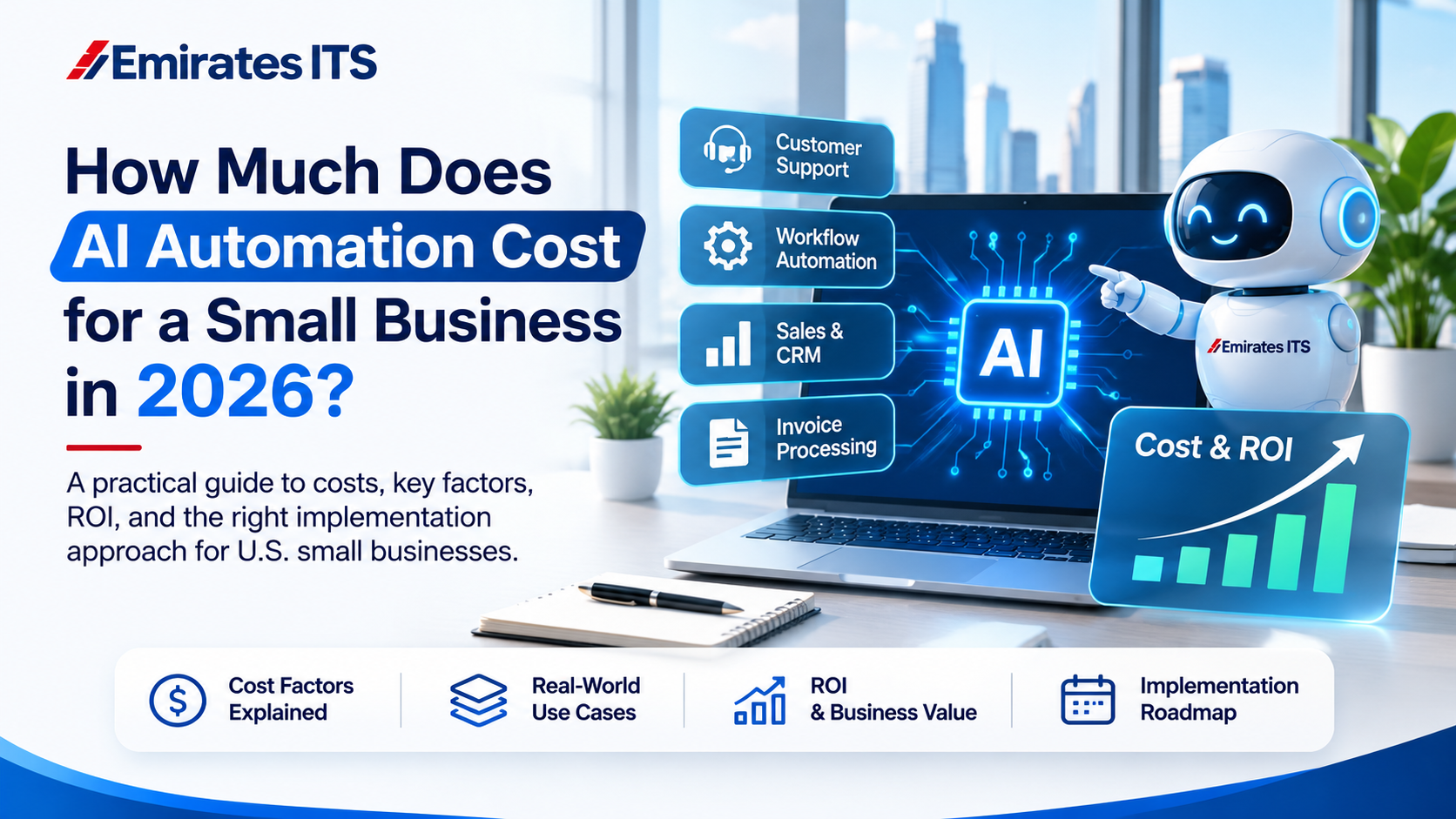
Discover what affects AI automation costs for small businesses in 2026, from software integrations and AI agents to maintenance, ROI, and implementation planning.
What Is AI Automation for Small Businesses?
AI automation helps small businesses reduce repetitive work by combining artificial intelligence with connected software systems. Instead of manually answering every routine inquiry, processing documents, or updating customer records, businesses can use automated workflows to complete these tasks more efficiently.
Common examples include AI customer support assistants, automated lead qualification, invoice processing, appointment scheduling, CRM updates, and intelligent document analysis. These solutions can help teams spend less time on administrative work and more time serving customers.
However, not every business process requires artificial intelligence. Simple, predictable tasks may be better handled by traditional rule-based automation. Choosing the right approach is an important part of controlling implementation costs.
How Much Does AI Automation Cost in 2026?
The cost of AI automation for a small business depends on workflow complexity, software integrations, data preparation, and customization. There is no universal price because a simple automated email workflow and a custom AI agent connected to multiple business systems require very different levels of development.
Small businesses generally choose between three approaches: automation features included in existing software, integrations that connect AI services to current business tools, and fully customized AI automation solutions. Existing platforms may be faster to deploy, while custom development can provide greater control over specialized processes.
When comparing AI automation pricing, account for implementation, software subscriptions, AI model usage, cloud hosting, maintenance, monitoring, and employee oversight. A realistic budget considers the total cost of ownership rather than the initial setup fee alone.
What Factors Affect AI Automation Development Costs?
Workflow complexity: Automating appointment reminders is usually simpler than developing an AI agent that interprets requests, retrieves company information, and performs several coordinated actions. More complex workflows generally need additional development, validation, and testing.
Software integrations: Connecting AI automation with CRM software, ERP systems, accounting platforms, email services, and internal databases can increase implementation effort. The availability and reliability of each platform's API also influence development costs.
Data quality and security: Incomplete records, inconsistent information, sensitive customer data, and compliance requirements may increase preparation and implementation work. Secure access controls and human approval steps are especially important for high-impact decisions.
Maintenance and scalability: AI automation systems need monitoring, updates, error handling, and periodic performance evaluation. Planning for future growth can reduce the risk of costly rebuilding as business requirements change.
Best AI Automation Use Cases for US Small Businesses
AI customer support automation: AI-powered assistants can classify customer inquiries, retrieve relevant information, and prepare suggested responses. Complex or sensitive requests can be transferred to employees for review.
Sales and CRM automation: Automated lead capture, follow-up reminders, customer segmentation, and CRM updates help sales teams manage opportunities consistently and reduce repetitive administrative work.
Invoice and document processing: AI document-processing systems can extract information from invoices, forms, and business records. Validation and human review remain important for financial accuracy.
Scheduling and operations: Appointment reminders, internal notifications, task assignments, and operational reporting can be automated to help teams manage daily activities more efficiently.
The best first project is usually a repetitive workflow that consumes measurable staff time, has clear success criteria, and can be tested without disrupting essential operations.
How to Calculate the ROI of AI Automation
Understanding AI automation ROI helps small businesses determine whether an investment is worthwhile. Compare implementation and ongoing costs with measurable benefits such as reduced manual work, faster processing, improved accuracy, and increased operational efficiency.
Consider a hypothetical US business that saves 15 employee hours per week through automation. At an estimated labor cost of $30 per hour, that represents $450 in weekly time value or approximately $23,400 annually. These are illustrative figures, not guaranteed financial savings.
To calculate actual returns, account for development costs, software subscriptions, hosting, maintenance, and human oversight. The best AI automation investments deliver measurable improvements that justify their total cost over time.
Why Choose Emirates ITS for AI Automation Development?
Emirates ITS provides custom software development, AI and intelligent automation, mobile application development, and digital engineering solutions for businesses seeking more efficient operations.
Our approach focuses on understanding business requirements, designing scalable software architecture, integrating existing systems, and developing customized AI solutions aligned with long-term business goals.
Looking to implement AI automation in your business? Whether you need intelligent customer support, CRM automation, or a custom AI-powered platform, Emirates ITS can help you build a solution tailored to your business needs. Book an AI Automation Consultation and take the next step toward smarter business operations.
Looking for help with AI & Intelligent Automation? Explore our AI & Intelligent Automation, portfolio, or contact our team.